Architectural Styles of Barnes
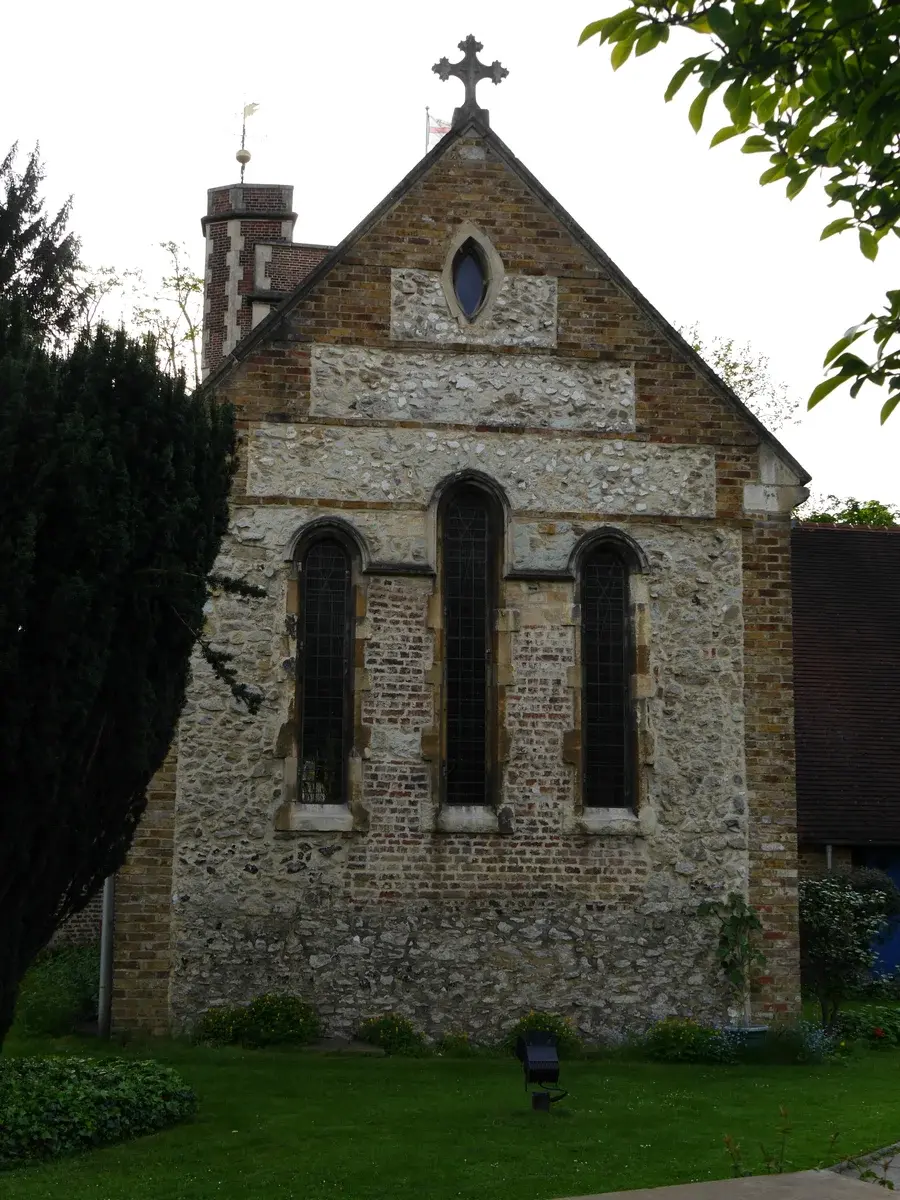
Barnes contains a rich mix of architectural styles spanning five centuries, shaped by its evolution from a medieval farming settlement to a prosperous Victorian suburb. The Barnes Green Conservation Area, designated on 14 January 1969 as one of the earliest in London, protects much of this built heritage, while approximately thirty listed buildings — including two at Grade II* — anchor the area’s architectural significance.
Tudor and Earlier Survivals
The oldest structural elements in Barnes date from the medieval period. St Mary’s Church retains a Norman chapel from circa 1100–1150 and a brick Tudor tower built around 1485 — the tower survived a fire in 1978 that destroyed later additions. Milbourne House on Station Road, Grade II* listed, preserves an Elizabethan fireplace and a seventeenth-century staircase behind a later Georgian facade, making it the oldest surviving private dwelling in Barnes.
Rose House at 70 Barnes High Street, a Grade II listed seventeenth-century former inn called “The Sign of the Rose,” retains its Jacobean timber frame beneath a pink-painted exterior. Old Essex House on Station Road, also Grade II, has origins in the sixteenth or seventeenth century.
Georgian (Eighteenth Century)
The Georgian period produced some of Barnes’s most distinctive buildings, particularly along The Terrace — a Thames-facing row where construction began in the 1720s. Twelve houses on The Terrace are Grade II listed, characterised by stucco or rendered facades in white and pastel colours. Originally built as summer residences for wealthy Londoners, they form a striking riverside composition.
Other Georgian survivals include the Sun Inn at 7 Church Road (Grade II, a Georgian coffee house, licensed from about 1776) and the Castelnau Villas — twenty pairs of classical villas at 84–122 and 91–125 Castelnau, designed by architect William Laxton in 1842 for Major Charles Lestock Boileau. Built from London stock brick with stucco ornament, all are Grade II listed.
Victorian (1837–1901)
The arrival of the railway in 1846 transformed Barnes from a quiet village into a commuter suburb, triggering a building boom that gave the area its predominant character.
Barnes Station (1846), attributed to architect John Thomas Emmett (though some sources credit William Tite) and built in Tudor Gothic style, is Grade II listed and the only survivor of four similar brick stations originally built on the Richmond branch line — those at Putney, Mortlake, and Richmond were later rebuilt. Barnes Railway Bridge, engineered by Joseph Locke and opened on 22 August 1849, retains its original cast-iron arches alongside the 1895 replacement structure and is Grade II listed.
Victorian terraces of the 1870s–1900s define whole streets: rows of London stock brick houses with slate roofs, prominent chimneys, bay windows, and decorative brickwork. Approximately fifteen large estates and their grounds were subdivided during this period to create housing for the growing middle-class population.
The Lion Houses on The Crescent, Glebe Road, and Hillersdon Avenue (1899–1903), built by developer James Nichols, are distinguished by their lion-topped gate piers — a quirky local landmark.
The Bull’s Head pub was rebuilt in 1846 with a tower added in the 1890s, and the White Hart on The Terrace was reconstructed in 1899.
Edwardian (1901–1914)
Edwardian Barnes saw larger, more spacious houses than their Victorian predecessors, with gabled roofs, decorative porches, and Arts and Crafts influences including ornamental tiles and stained glass.
Elm Bank Mansions on The Terrace (1906–1907), developed by Robert Emerson, are five-storey mansion flats with characteristic bay windows, built on the site of the eighteenth-century Elm Bank House. The Castelnau Mansions, fifty flats in two red-brick blocks dating from 1898, represent the Edwardian mansion-flat type near Hammersmith Bridge.
The former bank building at 15–17 Church Road (1905) shows the “Wrenaissance” style inspired by Sir Christopher Wren. The building at 117 Church Road began as Byfeld Hall in 1906, later becoming a cinema, a repertory theatre, and eventually the legendary Olympic Studios recording facility before its conversion back into a cinema in 2013.
Inter-War and Modern
The inter-war period left a lighter mark on Barnes, which was largely built up by 1914. Seaforth Lodge, a seven-storey Art Deco structure, is one of the few buildings from this era.
The most significant post-war architectural event was the fire at St Mary’s Church on 8 June 1978, which destroyed the Victorian and Edwardian additions. Architect Edward Cullinan designed the reconstruction, integrating a modernist interior with the surviving medieval and Tudor fragments. The church was re-hallowed on 26 February 1984.
Harrods Village represents a notable conversion project. The salmon-pink terracotta Harrods Furniture Depository, designed by William George Hunt and completed in 1914 using early Kahn-system reinforced concrete, was Grade II listed in 1990 and converted into 250 townhouses and penthouses in 2000.
Vernacular Character
Barnes’s architectural character is defined by several recurring elements:
- London stock brick (yellow) — predominant in Georgian and early Victorian buildings, especially on Castelnau
- Red brick — characteristic of later Victorian and Edwardian terraces
- Stucco and render — white or pastel-painted facades, particularly along the riverside
- Slate roofing — universal across nearly all periods
- Bay windows — a defining feature of Victorian and Edwardian streets
- Prominent chimneys — contributing to Barnes’s varied roofscape
- Long narrow plots — reflecting medieval burgage patterns, especially on the High Street
Conservation and Controversy
The conservation area designations — Barnes Green (1969, extended and modified several times, most recently in 2024), Mill Hill (1969), Barnes Common (1982), and Castelnau — impose planning controls that restrict demolition, require notification for tree works, and limit permitted development rights. Buildings of Townscape Merit carry a presumption against demolition.
The collapse of 26 The Terrace on 26 November 2015 during excavation for a basement extension became a high-profile case against “iceberg basements” in historic buildings. The Grade II listed Georgian house — once home to Ebenezer Cobb Morley, who bore a blue plaque — was destroyed when groundwork destabilised the structure on the Thames floodplain.
Image sources
- listed-buildings.webp — St Mary’s Church, Barnes. Author: Ethan Doyle White. License: CC BY-SA 4.0. Source
Sources
- Barnes Green Conservation Area Appraisal — London Borough of Richmond upon Thames (adopted 8 February 2024)
- The Terrace, Barnes — Wikipedia
- Barnes Station — Historic England (list entry 1239920)
- Harrods Furniture Depository — Wikipedia
- St Mary’s Church, Barnes — Wikipedia