The Coming of the Railway
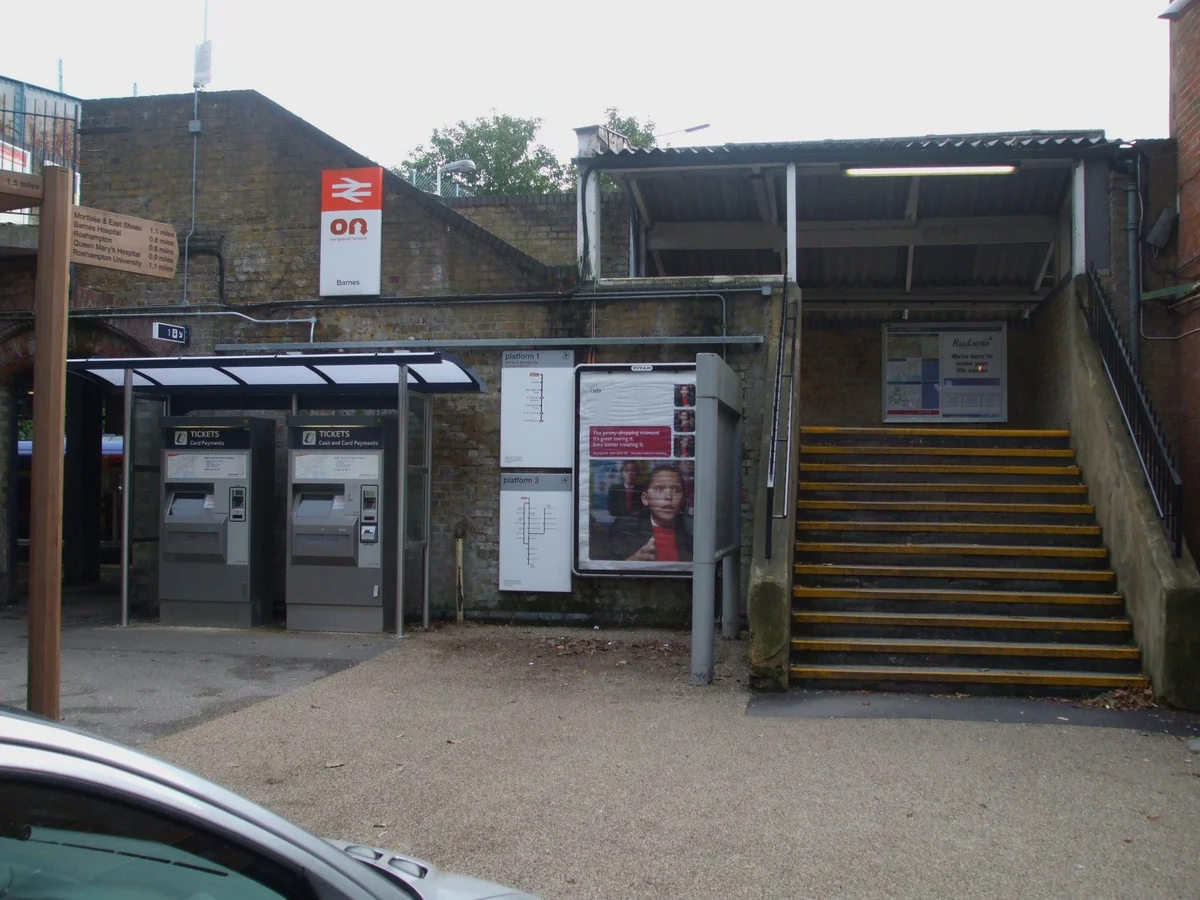
On 27 July 1846, Barnes changed forever. The London and South Western Railway opened a station on its new line to Richmond, and the quiet agricultural village on the Thames became a commuter suburb of London.
Barnes Station
Barnes station was designed by Sir William Tite (1798–1873), the architect of the Royal Exchange and twice president of the Royal Institute of British Architects. He produced a handsome building in the Tudor Gothic style: red brick with steep roofs, gables, tall chimneys, and pointed windows, giving it the character of a Victorian parsonage. It is the last remaining brick-built Gothic-style station on the Richmond branch line and holds Grade II listed status.
On 22 August 1849, Barnes became a junction station when the first section of the Hounslow Loop Line opened, providing a second route towards Windsor and Reading.
Barnes Railway Bridge
The Hounslow Loop required a new crossing of the Thames. The bridge was designed by the civil engineer Joseph Locke and built by Fox Henderson & Co. It opened on 22 August 1849 and consisted of two pairs of cast iron arch spans, each 36.6 metres long with a rise of 3.7 metres, supported on brick piers faced in Bramley Fall stone.
Following concerns about cast iron bridges in the 1890s, a replacement bridge was constructed alongside by engineer Edward Andrews. The original cast iron arches survive on the upstream side but have not carried rail traffic since the replacement opened.
Barnes Bridge Station
A second station, Barnes Bridge, opened on 12 March 1916 – the first day of the line’s electrification and one of the last new stations built by the London and South Western Railway. Located on the southern approach to the railway bridge, it gave its name to the surrounding area.
Transformation of Barnes
The arrival of the railway provoked protests from residents who feared it would destroy the village’s rural character. Their fears were partly justified: the convenient rail link to Waterloo triggered rapid suburban development. Market gardens gave way to rows of terraced houses in stock brick and red brick, particularly in the Westfield area and along the High Street.
By the end of the nineteenth century, Barnes had grown from a village of a few hundred to a community of nearly 10,000 people. The railway had accomplished in half a century what a thousand years of history had not – it had made Barnes part of London.
Today
Barnes station is served by South Western Railway, with regular trains to London Waterloo. The station lies in fare zone 3, approximately 11.4 km from Waterloo. Barnes remains a junction where the Hounslow Loop diverges from the main Richmond line, with services running to Reading and Windsor via Hounslow.
Image sources
- railway.webp — Barnes station northern entrance. Author: Sunil060902. License: CC BY-SA 3.0. Source
Sources
- Barnes railway station – Wikipedia
- Barnes Railway Bridge – Wikipedia
- The View at Barnes Bridge – History
- Sir William Tite – Wikipedia