Barnes Common
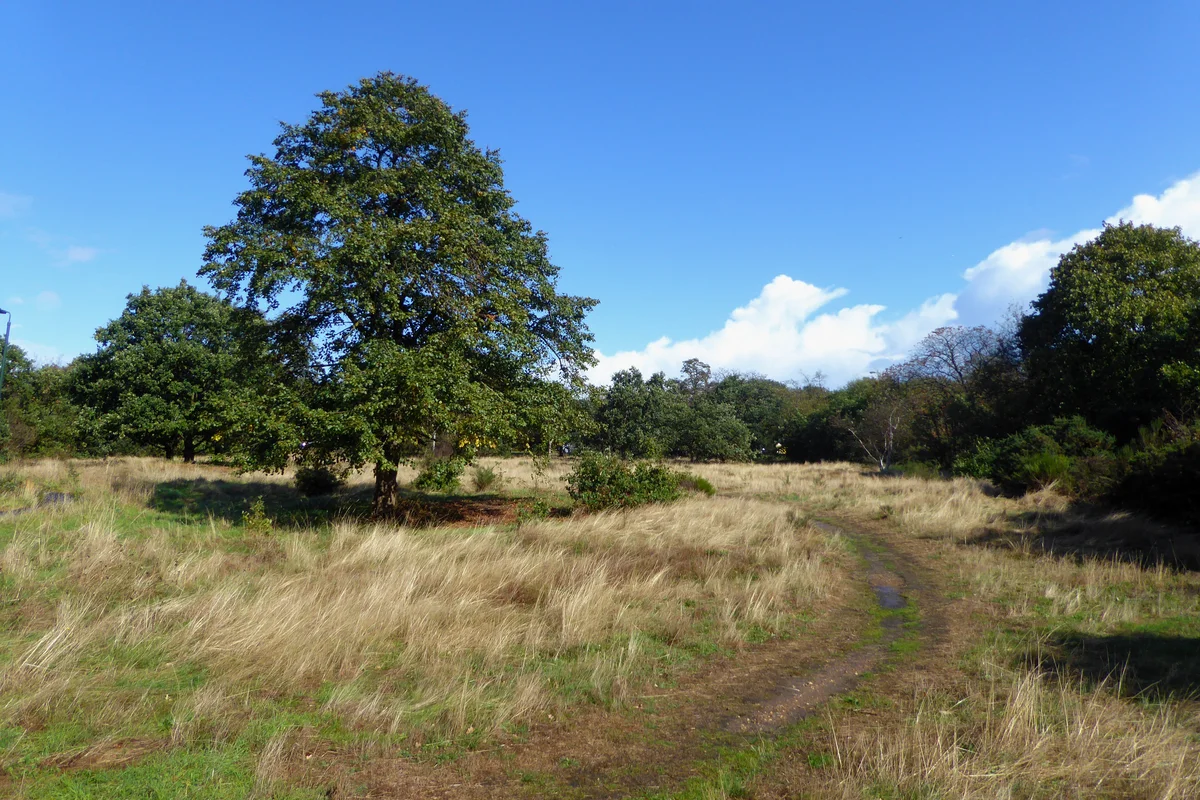
Barnes Common is one of London’s largest areas of common land, covering 49.55 hectares (122.4 acres) of grassland, woodland, and reed-beds in the south-east of Barnes. Designated a Local Nature Reserve in 1992, it is home to nationally scarce lowland acid grassland and has been used as common land for over a thousand years.
History
For centuries Barnes Common served as rough grazing land, sometimes called “The Waste,” where commoners cut gorse for firewood. The land has been owned by the Dean and Chapter of St Paul’s Cathedral since a grant by King Athelstan around 925. Over the centuries, the Cathedral’s lessees repeatedly clashed with local residents over grazing rights.
In 1589 the men of Barnes refused to let their Putney neighbours share the Common, and the boundary was fixed in the 1590s. A more dramatic confrontation came in 1614, when a new owner enclosed the entire common, dug ditches to prevent grazing, and removed locals’ cattle. One hundred residents marched to petition the King, and a court hearing reversed the enclosure.
In the 1890s the local Vestry attempted to extend the cemetery onto Common land, but the Commons Preservation Society defeated the proposal.
Ecology
Barnes Common’s greatest ecological treasure is its lowland acid grassland, a nationally scarce habitat. Characteristic species include sheep’s fescue, wavy hair-grass, sheep sorrel, and heath bedstraw. The burnet rose, present for over three hundred years, is not known from anywhere else in London.
The light, dry, acidic soil provides ideal conditions for mining bees, burrowing wasps, and the green hairstreak butterfly. Mammals include foxes, badgers, hedgehogs, and two species of vole that sustain a nightly-hunting tawny owl. Robins and wrens are the most numerous birds, with blue tits and great tits common in the wooded sections.
The Common was drained in the second half of the nineteenth century; before that it was virtually marshland.
Beverley Brook
The Beverley Brook rises in Worcester Park and flows approximately 8.9 miles (14.3 km) through Greater London before joining the Thames north of Putney Embankment at Barn Elms. It runs along the Common’s north-west boundary and also edges Barnes Green, where a footbridge connects the two spaces. Barnes Common Limited is working on a restoration project to improve flood resilience and create healthier water flows, including new channels and small islands on Barnes Green.
Boundaries
The Common is bounded by Vine Road to the west, Beverley Brook to the north-west, Ranelagh Avenue and the Rythe (a raised bank) to the north, a historic ditch separating it from Putney Lower Common to the east, and Upper Richmond Road (A205) to the south.
Cricket
Cricket was played on Barnes Common as early as August 1736, when a match between Surrey and London was recorded here. Barnes Common Cricket Club was founded in 1976 and secured Vine Road as its permanent home ground in the 1990s. The club celebrated its fiftieth year in 2025 and plays “taverners” cricket – informal, inclusive, and open to all abilities. Overseas tours have taken the club to Holland, India, Australia, the West Indies, Ireland, and Italy.
Barnes Old Cemetery
In the north-east corner of the Common, off Rocks Lane, lies Barnes Old Cemetery. Two acres of sandy ground were purchased by the Church of England in 1854 for £10 to relieve the overcrowded churchyard at St Mary’s. A chapel and lodge were built, and the cemetery remained in use until the mid-1950s. The chapel was later demolished and many headstones vandalised. The Council has declared the site a nature reserve, and it is effectively part of Barnes Common again. Ebenezer Cobb Morley, founder of the Football Association, is buried here alongside his wife Frances.
Management
Barnes Common is managed by Barnes Common Limited (charity no. 1153079) in partnership with the London Borough of Richmond upon Thames. Over one hundred volunteers help with conservation work, including water-quality testing in Beverley Brook, invertebrate surveys, and community planting projects.
Railway
Barnes station opened on 27 July 1846 on the edge of the Common. In May 1846 local copyholders complained that the railway company had trespassed on Common land by building the station outside the allotted area. The arrival of the railway transformed Barnes from a rural hamlet into a commuter suburb, as market gardens gave way to residential development.
Image sources
- barnes-common.webp — Barnes Common. Author: Ethan Doyle White. License: CC BY-SA 4.0. Source
Sources
- Barnes Common – Wikipedia
- Barnes Common Limited (official website)
- London Borough of Richmond upon Thames – Barnes Common
- Barnes Common and Mill Hill Conservation Area Study (Richmond Council)