Beverley Brook
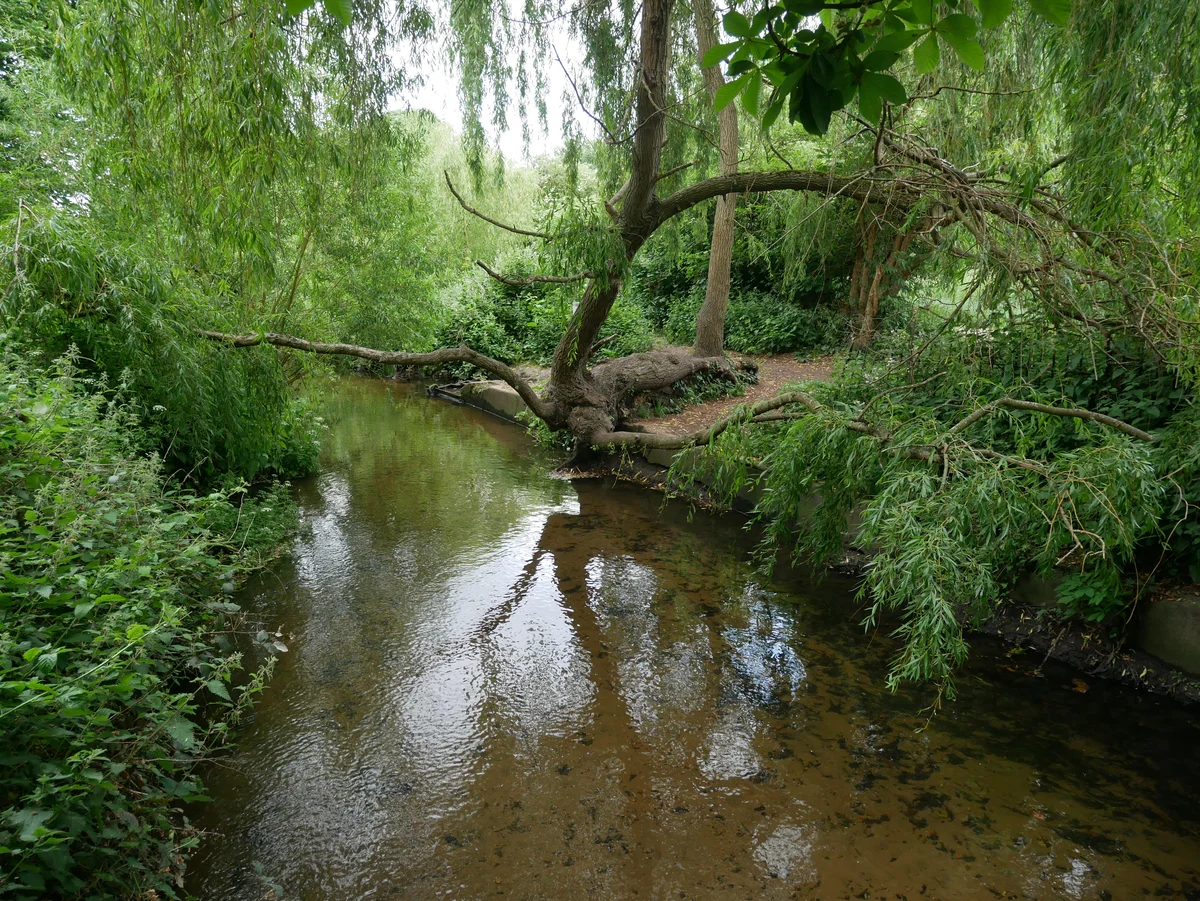
Beverley Brook is a 14.3-kilometre stream that rises in Worcester Park and flows north through Richmond Park and Barnes Common before entering the Thames near Barn Elms. Its name comes from the Old English beofor (beaver) and leah (meadow or clearing) – the “Beaver Meadow” – a reminder that European beavers once inhabited these waters before their extinction in Britain in the sixteenth century. The earliest recorded form of the name, Beferithi, dates to 693 AD.
Course
The brook begins on a hilltop in Cuddington Recreation Ground and runs its first kilometre underground in a culvert beneath residential streets. It surfaces near Worcester Park, then flows north through suburban Motspur Park, where the Pyl Brook joins it at Beverley Park. The stream runs along the western edge of Wimbledon Common before entering Richmond Park at Robin Hood Gate. After two kilometres through the park – where red and fallow deer drink at its banks – it crosses into Barnes, flowing through Barnes Common and past the Barnes Old Cemetery before meeting the Thames at Leader’s Gardens, near Barn Elms and the WWT London Wetland Centre.
The catchment covers sixty-four square kilometres across four London boroughs: Sutton, Kingston upon Thames, Merton, and Richmond upon Thames. For much of its length, the brook serves as the historic boundary between boroughs.
Wildlife
The brook supports kingfishers, grey herons, little egrets and grey wagtails. In the scrub and dense vegetation along Beverley Brook on Barnes Common, Cetti’s warblers, blackcaps and chiffchaffs breed. Fish species include chub, dace, roach, perch and European eel. In restored sections of Richmond Park, barbel and flounder have been recorded for the first time, and stone loach have appeared outside the park.
Pollution and Water Quality
The brook faces persistent pollution challenges. A significant proportion of its flow originates from Hogsmill Sewage Treatment Works. Misconnected domestic sewers discharge raw sewage into the stream, and the Roehampton Vale combined sewer overflow, just two hundred metres from the entrance to Richmond Park, discharged 270 times in a single year. The Environment Agency classifies the brook’s ecological status as “moderate” and its chemical status as “fail,” with elevated levels of PFAS compounds and cypermethrin.
Restoration
Since 2015, the South East Rivers Trust and The Royal Parks, with patronage from Sir David Attenborough, have restored more than six hundred metres of the brook’s channel through Richmond Park. Twenty tonnes of concrete were removed from the banks, which were reprofiled into natural slopes. Nine thousand native plants and two hundred trees were planted by volunteers. Scientific monitoring has documented rapid recovery: invertebrate density increased by up to 148 per cent, and fish species previously absent from the park have colonised the restored sections.
On Barnes Common, new reedbeds are being created as part of a six-million-pound flood resilience project funded by DEFRA, in partnership with the London Borough of Richmond and the WWT. The reedbeds will absorb floodwater during high tides and heavy rain, and their connection to the brook will create refuge habitat for young fish.
Image sources
- beverley-brook.webp — Beverley Brook, Barnes. Author: Doyle of London. License: CC BY-SA 4.0. Source
Sources
- Beverley Brook – Wikipedia
- Beverley Brook – South East Rivers Trust
- Beverley Brook – Barnes Common Limited
- “Putting the ‘Beaver’ Back in Beverley Brook” – MDPI Water (2021)
- Beverley Brook Operational Catchment – Environment Agency