Henry Fielding and Literary Barnes
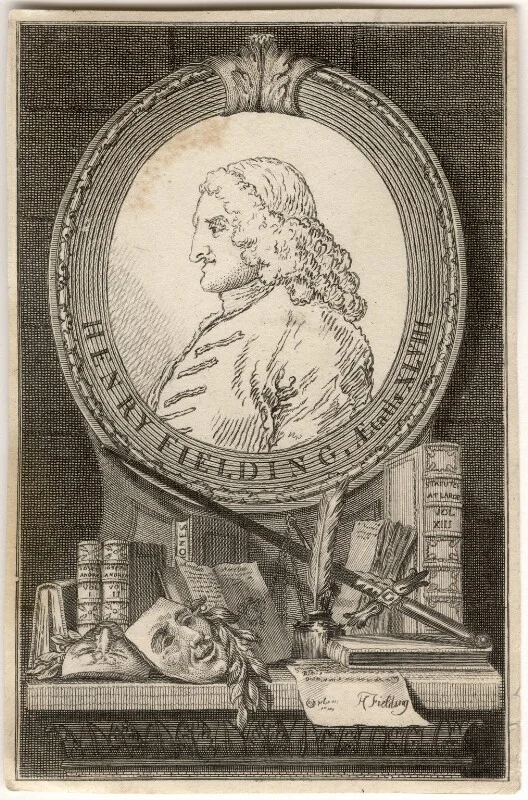
Barnes has a literary heritage stretching back more than three centuries. The village’s most famous literary resident was Henry Fielding, the novelist who helped establish the English novel as a literary form. He lived at Milbourne House on Station Road, facing Barnes Green, around 1750, writing his final novel Amelia in what is today the oldest private residence in Barnes.
Henry Fielding (1707–1754)
Life and Career
Henry Fielding was born on 22 April 1707 at Sharpham Park, near Glastonbury, Somerset. Educated at Eton College and the University of Leiden, he first made his name as a dramatist and satirist in the London theatre. His writing career shifted to prose fiction after the Licensing Act of 1737 effectively curtailed political satire on stage.
His major novels transformed English literature:
- Shamela (1741) — a parody of Samuel Richardson’s Pamela
- Joseph Andrews (1742) — began as a Pamela parody but became an original comic novel
- The History of Tom Jones, a Foundling (1749) — his masterpiece, which Coleridge called one of “the three most perfect plots ever planned”
- Amelia (1751) — his final novel, written at Milbourne House in Barnes
Connection to Barnes
Fielding lived at Milbourne House, facing Barnes Green, in approximately 1750. He had recently published Tom Jones to enormous success and was simultaneously serving as Justice of the Peace for Westminster. By this time, his health was declining — he suffered from gout, asthma, and what would prove to be cirrhosis of the liver. Barnes, then a semi-rural village offering clean air and tranquillity, suited a man in poor health seeking respite from central London.
It was at Milbourne House that Fielding wrote Amelia, published in December 1751 to an initial print run of 5,000 copies. The novel is considered the first English novel of social protest and reform, drawing on his experiences as a magistrate.
Beyond Literature
Fielding was appointed Justice of the Peace for Westminster in 1748, working from his house at Bow Street, Covent Garden. In 1749, he founded the Bow Street Runners — widely regarded as London’s first professional police force. His half-brother Sir John Fielding succeeded him as magistrate and expanded the system.
Fielding died in Lisbon on 8 October 1754, aged 47, having travelled to Portugal seeking the warmer climate for his health. He is buried at the British Cemetery in Lisbon.
Milbourne House
Milbourne House, at 18 Station Road, is the oldest private residence in Barnes, with parts dating to the sixteenth century. It is Grade II* listed — a designation given to only about 5.8 per cent of listed buildings, indicating particular importance.
The house is named after the Milbourne family of Surrey (historically also spelt Milborne), who held the Manor of Esher Wateville in the fourteenth and fifteenth centuries. It has an early eighteenth-century facade concealing older features, including a seventeenth-century staircase and chimney piece.
Before Fielding, the house was home to Robert Beale (1541–1601), Clerk of the Privy Council and secretary to Sir Francis Walsingham, Elizabeth I’s spymaster. Beale was one of those who carried the warrant for the execution of Mary Queen of Scots to Fotheringhay Castle and witnessed the execution. He is believed to have died at Milbourne House in 1601, though some sources place his final residence at nearby Barn Elms.
A blue plaque for Henry Fielding was erected on the house in 1978 by the Greater London Council.
The Kit-Cat Club at Barn Elms
Barnes’s literary connections predate Fielding by half a century. Around 1703, Jacob Tonson the Elder — the most important English publisher of the late seventeenth century, who published Dryden, Milton, and acquired the copyright to Shakespeare’s plays — purchased a property at Barn Elms and built a dedicated room for the Kit-Cat Club, the most influential literary and political club of the age.
Members who met at Barn Elms included Joseph Addison, Richard Steele, William Congreve, John Vanbrugh, and Robert Walpole (later Britain’s first Prime Minister). Sir Godfrey Kneller painted approximately forty-eight portraits of the members, which were displayed at Barn Elms; they are now in the National Portrait Gallery. Alexander Pope was a regular visitor in the 1720s and 1730s.
Later Literary Figures
Barnes continued to attract writers through the centuries:
- Judith Kerr OBE (1923–2019) — the German-born children’s author of The Tiger Who Came to Tea and the Mog series lived in the same house in Barnes for 57 years
- Roger McGough CBE (b. 1937) — the Liverpool poet and broadcaster lives in Barnes and serves as patron of the Barnes Literary Society
- Barbara Pym (1913–1980) — the novelist lived at 47 Nassau Road
- Dodie Smith (1896–1990) — author of The Hundred and One Dalmatians, lived at 35 Riverview Gardens
- Eric Newby (1919–2006) — the celebrated travel writer grew up in Castelnau Mansions
The Barnes Literary Society, founded in 2004, continues the tradition with monthly literary events and the annual Barnes BookFest.
Image sources
- henry-fielding.webp — Henry Fielding, engraving after Hogarth. Public domain. Source
Sources
- Henry Fielding — Wikipedia
- Henry Fielding Blue Plaque — English Heritage
- 18 Station Road, Barnes — Wikipedia
- Jacob Tonson — Wikipedia
- Milbourne House — Barnes & Mortlake History Society