Barnes Green and Pond
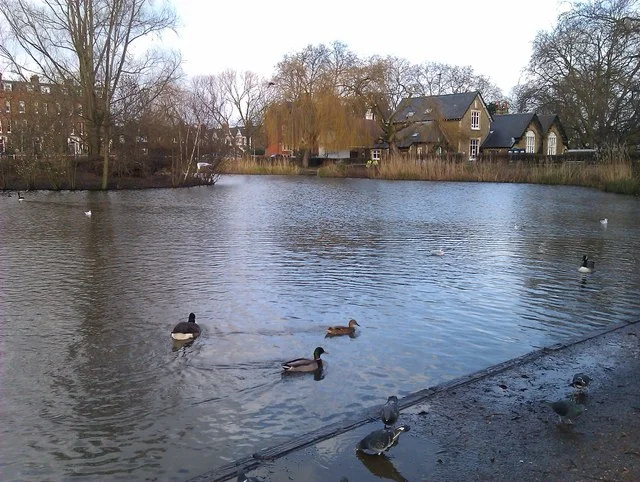
Barnes Green is the heart of Barnes. This triangle of grass, centred on its duck pond, has served as the village gathering place for centuries. Surrounded by historic buildings, pubs, and the twelfth-century church of St Mary, the Green gives Barnes its distinctive character as a village within London.
History
The Green has been at the centre of Barnes life since at least the twelfth century, when the original Norman chapel of St Mary’s was built nearby (between 1100 and 1150). In 1215, shortly after the sealing of Magna Carta, Archbishop Stephen Langton of Canterbury stopped at Barnes on the river to re-consecrate the enlarged church.
Originally there were three ponds on the Green; only the Great Pond, now known as Barnes Pond, survives today.
Barnes Pond
The pond is the focal point of the Green and, for many residents, of Barnes itself. It is home to numerous breeding pairs of ducks, swans, and other waterbirds. Feeding the ducks has long been described as a “rite of passage for the children of Barnes.”
In April 2001, the pond mysteriously drained within 48 hours. The Barnes Community Association launched a fundraising appeal for £200,000, supplemented by a £60,000 council grant, and the Wildfowl and Wetlands Trust provided expert advice. The pond was relined and refilled in April 2003, and it is now maintained partly through funds raised at the annual Barnes Fair.
Cricket on the Green
Cricket has been played on Barnes Green since at least 1835, when Barnes Cricket Club was first recorded. In the late 1890s, the pitch moved to Scarth Road on Barnes Common, partly because of conflicts with livestock drovers who damaged the playing areas while watering their animals at the pond on the way to London markets. The displaced cricketers set up their new ground near Barnes railway station, with a railway carriage serving as their changing room.
Conservation Area
Barnes Green was designated a conservation area on 14 January 1969 – one of the earliest in the Borough of Richmond upon Thames. The area has been extended five times: in 1982 (Cleveland Road), 1988 (Malthouse Passage and part of Stanton Road), 2004 (Grange Road and part of Kitson Road), 2018 (Elm Bank Gardens), and 2024 (boundary rationalisations).
Surrounding Landmarks
The Green is ringed by buildings of historic and architectural interest:
- St Mary’s Church – Norman origins (c. 1100–1150), consecrated by Archbishop Langton in 1215
- Milbourne House – the oldest private dwelling in Barnes, with parts dating to the fifteenth century, facing the pond from Station Road
- The Sun Inn – a Georgian coffee house (c. mid-eighteenth century) on Church Road, overlooking the pond; it has held a beer licence since about 1776
- The Red Lion – first registered as “The Strugglers” in 1718, destroyed by fire in 1835 and rebuilt as the Red Lion
Events
Barnes Green hosts the annual Barnes Fair, organised by the Barnes Community Association, with over 300 stalls, vintage fairground rides, and live music. The Green also hosts the Barnes Food Fair (September) and the Barnes Christmas Festival.
Practical Information
Barnes Green is connected to Barnes Common via a footbridge over Beverley Brook at the northern end. The nearest stations are Barnes (5 minutes’ walk) and Barnes Bridge (10 minutes’ walk).
Image sources
- barnes-green.webp — Duck pond on Barnes Green. Author: David Martin. License: CC BY-SA 2.0. Source
Sources
- London Borough of Richmond upon Thames – Barnes Green
- Barnes Community Association – Barnes Pond
- Barnes Green Conservation Area Appraisal
- Barnes Common – Half a Century of Cricket