Barnes Railway Bridge
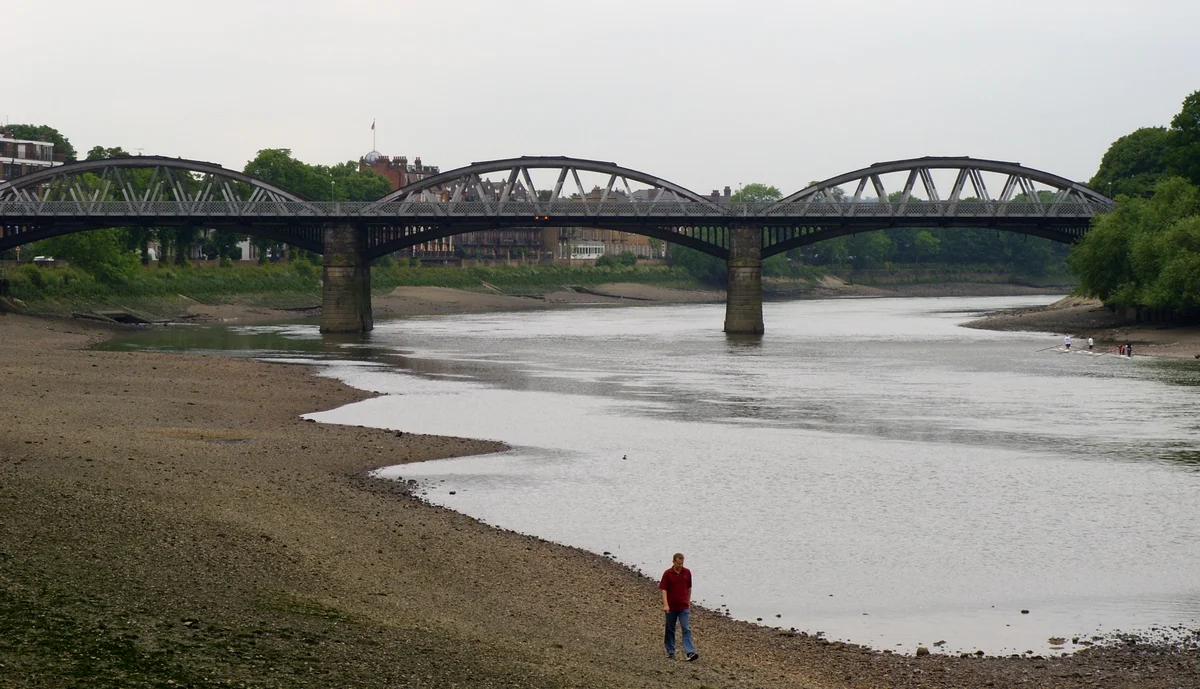
Two bridges stand side by side across the Thames between Barnes and Chiswick – one of cast iron from 1849 that no longer carries trains, and one of wrought iron from 1895 that does. Together they form a Grade II listed structure and one of the most distinctive landmarks on the river.
The Original Bridge (1849)
The bridge was designed by the civil engineer Joseph Locke for the London and South Western Railway’s Hounslow Loop Line. It opened on 22 August 1849. The structure comprised two pairs of cast iron arches, each spanning 36.6 metres with a rise of 3.7 metres. Each arch was cast in four sections and reinforced with six ribs, each 915 mm deep. The arches rested on brick piers faced in Bramley Fall stone and carried a timber deck.
Replacement (1895)
On 1 May 1891, a cast iron girder on the railway bridge at Norwood Junction fractured under an express train, prompting a national review of all similar structures. An Act of Parliament in July 1891 authorised the replacement of Barnes Bridge. Engineer Edward Andrews designed a new structure of three wrought iron bowstring trusses, built alongside the original by Head, Wrightson & Co. It opened in June 1895, and a pedestrian walkway 2.4 metres wide was added – one of only three combined rail and pedestrian crossings of the Thames in London.
The original cast iron arches were left standing on the upstream side. Three of them survive today, silent witnesses to the Victorian railway age.
The Boat Race
Barnes Bridge is the last bridge the Oxford and Cambridge crews pass beneath before the finish at Mortlake. The sharp bend in the river at this point gives a tactical advantage to the crew on the inside, and the bridge is widely considered the most popular spectator position on the course. A tradition holds that the crew leading at Barnes Bridge almost always wins – though in 1886, Cambridge proved the rule wrong.
Recent Repairs
In the summer of 2024, Network Rail replaced connecting pins and all forty-eight Victorian wheel timbers on the London-bound track. In August 2025, the central girders were replaced and the remaining wheel timbers renewed, lifting a weight restriction that had been in place for fifty years since a 1976 redecking.
The View at Barnes Bridge
A community initiative led by the Barnes Community Association aims to transform the disused 1849 bridge into a landscaped pedestrian walkway – a green corridor across the Thames, conceived in the spirit of New York’s High Line. Designed by Moxon Architects, the project would restore the Victorian structures and create a two-metre-wide planted promenade. A feasibility study estimated costs at approximately three million pounds.
Image sources
- barnes-railway-bridge.webp — Barnes Bridge at low tide. Author: Iridescenti. License: CC BY-SA 3.0. Source
Sources
- Barnes Railway Bridge – Wikipedia
- Barnes Railway Bridge – Historic England (List Entry 1080861)
- History – The View at Barnes Bridge
- Engineering Timelines – Barnes Rail Bridge
- Norwood Junction rail accident – Wikipedia