Harrods Village
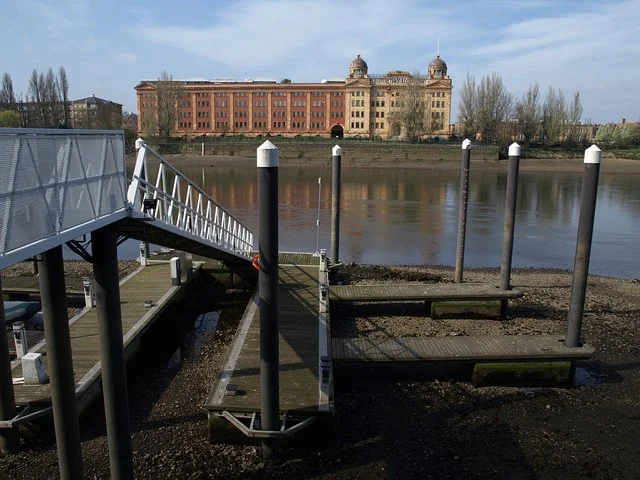
Harrods Village is a private gated residential development on the south bank of the Thames in north Barnes, converted from the former Harrods Furniture Depository. The Grade II listed riverside building, with its distinctive salmon-pink terracotta facade, is one of the most recognisable landmarks along the Oxford and Cambridge Boat Race course.
The Furniture Depository
Before Harrods
The riverside site was originally occupied by Colonel Lewis Cowan’s Hammersmith Bridge Works, a soap and sugar refinery built in 1857. A major fire destroyed the sugar refinery in 1888, temporarily putting approximately 500 staff out of work. The works closed permanently in 1892.
Construction and Purpose
In 1893, Richard Burbidge, Managing Director of Harrods department store, acquired the site. Burbidge lived in Barnes himself, and when Cowan’s land became available, he quickly secured it. The depository was conceived to store large furniture and household goods — particularly for British expatriates and colonial administrators posting abroad during the height of the Empire.
The depository officially opened in 1894 with a lavish fete and carnival in aid of Holy Trinity Church, Barnes, attended by over 4,000 people.
Between 1911 and 1914, the distinctive salmon-pink terracotta riverside facade was added under the direction of architect William George Hunt. The design was deliberately conceived to harmonise with Harrods’ flagship Knightsbridge store, employing an elaborate Edwardian Baroque style with neoclassical influences. The building used the Kahn system of reinforced concrete, noted by Historic England as a remarkably pure early British example of this technique.
The planned north wing was never completed due to the outbreak of the First World War in 1914, giving the building its characteristic asymmetry.
Architecture
The main building is five storeys tall with two cupolas and a central tower. The facade features keyed architraves to tripartite windows and pedimented end bays. A flight of fifteen steps flanked by bronze uplighters leads to a round-arched projecting porch. The interior retains a fine Baroque-style entrance hall clad in Carrara marble, with coffered ceiling supported on brackets.
The rear elevation has access galleries on reinforced concrete cantilevers, considered particularly significant by heritage specialists. The building also retains original riverside loading bays with a dedicated quay.
The depository was Grade II listed in 1990 and sits within the Castelnau Conservation Area.
Conversion to Residential
In July 1996, planning permission for residential conversion was granted by the London Borough of Richmond upon Thames. Harrods Holdings sold the site to Berkeley Homes in June 1997, and the conversion was completed by 2000.
The scheme, designed by Michael Lyell of ML Design Group, encompassed three historic buildings converted into approximately 250 apartments, penthouses, and townhouses across an 11-acre site:
- William Hunt Mansions — the main riverfront depository (named after the architect)
- Charles Harrod Court — the converted soap factory (named after Harrods’ founder)
- Richard Burbidge Mansions — the converted candle factory (named after the managing director who established the depository)
The conversion preserved the external terracotta facades, the Carrara marble entrance hall, and the original “HARRODS FURNITURE DEPOSITORY” signage that remains on the building.
Today
Harrods Village is a gated residential community with 24-hour concierge, a 25-metre swimming pool, gymnasium, landscaped gardens, and underground parking. The development is purely residential with no commercial spaces. The buildings are no longer owned by Harrods. The development sits adjacent to the Castelnau council estate, reflecting the social mix of the wider neighbourhood.
William Hunt Mansions remains a key marker post on the annual Boat Race — television commentators regularly reference the building as the crews pass.
Practical Information
The nearest station is Barnes Bridge, under 25 minutes to Waterloo by South Western Railway. Bus routes 33, 485, and 419 serve the area. The development is accessed from Somerville Avenue, off Castelnau.
Image sources
- harrods-village.webp — Former Harrods Furniture Depository. Author: Derek Harper. License: CC BY-SA 2.0. Source
Sources
- Harrods Furniture Depository — Wikipedia
- Harrods Depository — Historic England (List Entry 1254280)
- Harrods Village Barnes SW13 — RiverHomes
- Harrods Depository — Barnes Village