St Mary's Church
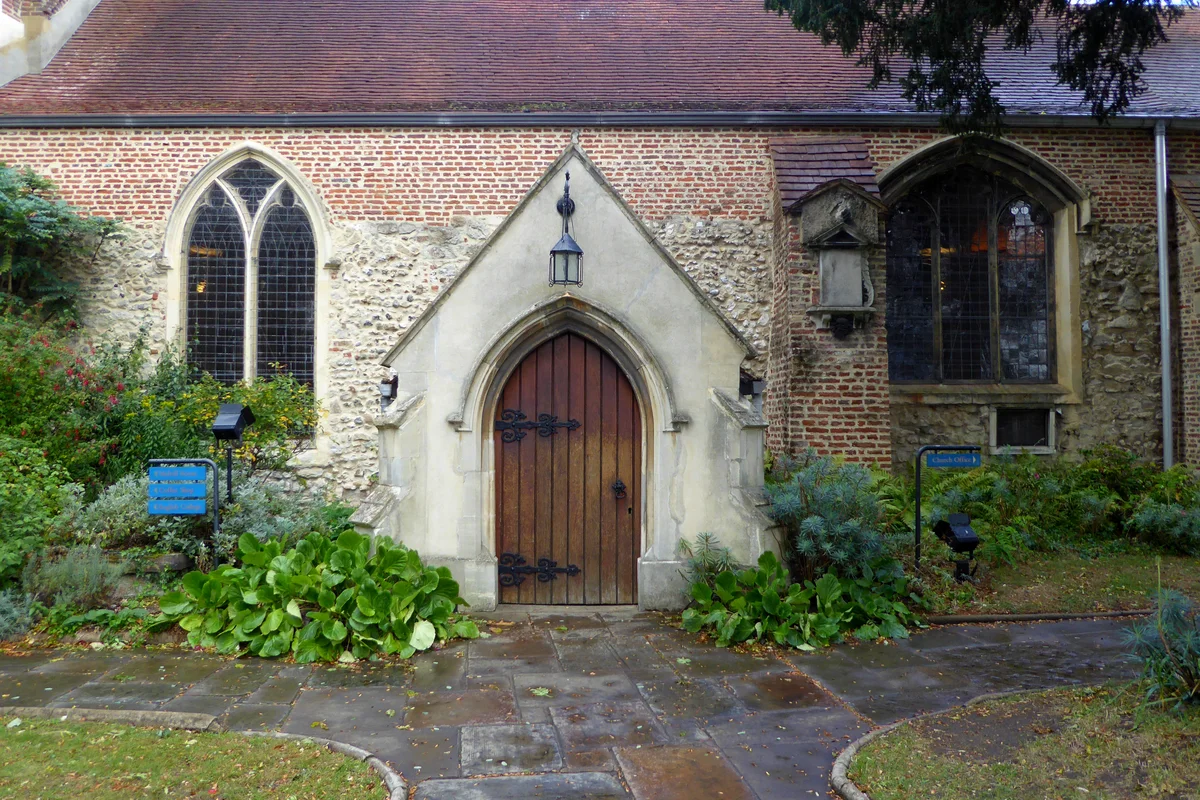
St Mary’s Church stands at the heart of Barnes, where it has served the community for over nine hundred years. A Grade II* listed building, it combines a Norman chapel, a Tudor tower, and a striking modern interior designed by Edward Cullinan after a devastating fire in 1978.
Norman Origins
The original chapel was built between 1100 and 1150, its walls constructed of coursed flint. In the early thirteenth century the building was extended westward to enlarge the nave and eastward to add a chancel with triple lancet windows.
In 1215, shortly after the sealing of Magna Carta at Runnymede, Archbishop Stephen Langton of Canterbury stopped at Barnes on his journey along the river and re-consecrated the enlarged church. Langton had been a central figure in the negotiations between King John and the barons. The oldest surviving part of the church is now known as the Langton Chapel in his honour.
Later Medieval and Tudor Development
Around 1485 a brick west tower was added – a distinctive feature that survived both the centuries and the later fire. In the late eighteenth century the north wall was removed to create a north aisle, substantially enlarging the interior.
The Fire of 1978
On 8 June 1978 fire largely destroyed the church. Victorian and Edwardian additions were lost, but the Tudor tower, much of the original chapel, and several hidden twelfth- and thirteenth-century elements were revealed by the destruction.
Cullinan’s Rebuild
Architect Edward Cullinan took the bold approach of designing a modern interior that respected the medieval spirit of the original building. He added a new nave and crossing to the surviving fifteenth-century tower and medieval chancel, using minimal supporting structure and natural materials. The church was re-hallowed on 26 February 1984.
In 1985 St Mary’s became the first winner of the International Interior Design Award. The design allows three hundred people to see without obstruction and hear without amplification, while smaller gatherings can fill the intimate subsidiary spaces comfortably.
Churchyard
The churchyard is walled and extensively gardened, with a specimen yew tree and a lych gate entrance. The earliest dated memorial belongs to Edward Rose, buried on 7 July 1653. Other notable burials include Sir Lancelot Shadwell (1779–1850), the last Vice Chancellor of England.
The Barnes War Memorial in the churchyard was given Grade II listing in 2017 as part of the centenary of the First World War. It features a tall octagonal stone shaft with a sculpture of Christ, resting on a plinth whose faces bear decorated shields representing the instruments of the Passion.
By 1854 the churchyard was full, and Barnes Cemetery was opened on Barnes Common to provide additional burial space. Ebenezer Cobb Morley, the founder of the Football Association, and Francis Turner Palgrave (d. 1897), compiler of the Golden Treasury of poetry, are buried in that cemetery rather than at St Mary’s.
Music and Community
St Mary’s is the principal venue for the Barnes Music Festival, an annual celebration of music held each March with around thirty-five events across Barnes over a fortnight. The Barnes Music Society holds most of its concerts here, and the church runs a parish choir and a junior choir for children from the age of seven.
Image sources
- st-marys-church.webp — St Mary’s Church, Barnes. Author: Ethan Doyle White. License: CC BY-SA 4.0. Source
Sources
- St Mary’s Church, Barnes – Wikipedia
- History & Architecture – St Mary’s Barnes (official website)
- Church of St Mary – Historic England (List Entry 1358083)
- St Mary’s Barnes – Magna Carta Trust 800th Anniversary