The Terrace
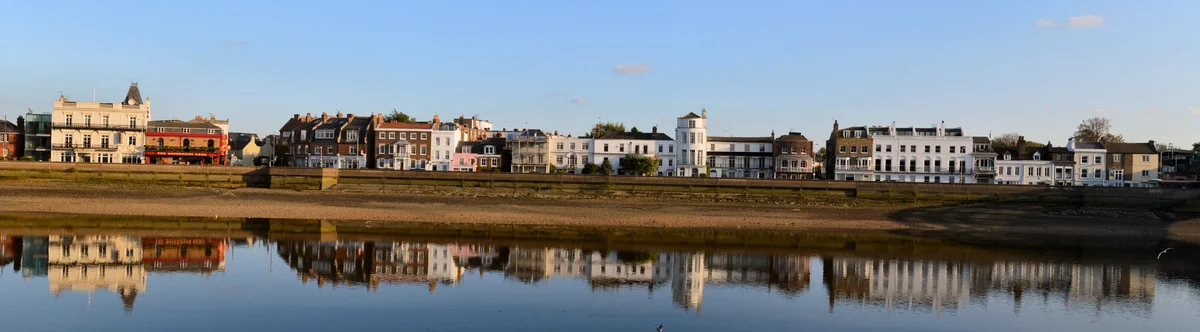
The Terrace is a row of Georgian houses overlooking the River Thames, widely considered the most picturesque street in Barnes. Built from the 1720s onwards, with the main development from about 1740, these houses face the river on one side only, giving every property an uninterrupted view across the water.
History
The larger houses on The Terrace were originally let to wealthy Londoners as summer residences – the riverside location was considered too damp for year-round occupation. The smaller houses were occupied by watermen, the boatmen who ferried passengers across the Thames, and their presence here dates back to at least the fourteenth century.
After the construction of the Thames Embankment in central London, the river was effectively ponded back upstream, leading to regular flooding along The Terrace. Many houses still bear the fixings for flood boards that once protected their ground floors. A flood wall was built to defend the street, though its height was limited after residents protested against the original, taller plans.
Architecture and Heritage
The Terrace comprises a mix of two- and three-storey Georgian brick houses, many with white-painted balconies. Numerous properties are Grade II listed, including numbers 3, 7, 7A, 8, 9, 10, 11, 13, 14, 28, 30, and 31. The street falls within the Barnes Green Conservation Area.
Notable Residents
The Terrace has been home to an exceptional concentration of creative and public figures:
- Ebenezer Cobb Morley (26 The Terrace, 1858–1924) – the “Father of Modern Football,” who founded Barnes Football Club in 1862 and drafted the original Laws of the Game in this house. An English Heritage blue plaque was installed before the house collapsed during basement extension works in November 2015.
- Gustav Holst (10 The Terrace, 1908–1913) – the composer lived here before moving to Brook Green; a blue plaque marks the Grade II listed house.
- Ninette de Valois (14 The Terrace, 1962–1982) – the founder of the Royal Ballet; commemorated with a blue plaque.
- William Ernest Henley (9 The Terrace) – the poet who wrote “Invictus” and whose personality inspired Robert Louis Stevenson’s Long John Silver in Treasure Island.
The Boat Race
The Terrace offers one of the finest vantage points for watching the Oxford and Cambridge Boat Race. Situated near the final bend before the Mortlake finish, spectators gather along the pavement and on pub balconies to watch the crews sprint through their closing minutes. The White Hart pub, an imposing four-storey building at the eastern end of The Terrace, hosts a Boat Race Gala Lunch with views from its first-floor balcony.
The White Hart
The White Hart (also known as Ye White Hart) has stood on The Terrace since 1662. The current building dates from 1899 and was fully renovated in 2013. Operated by Young’s, the pub has riverside verandas and tables on the towpath in summer. Its Terrace Kitchen restaurant occupies the first floor.
Practical Information
Barnes Bridge station is situated directly on The Terrace, providing quick access to Waterloo via South Western Railway. The street connects Barnes High Street at one end with the riverside path towards Hammersmith at the other.
Image sources
- the-terrace.webp — The Terrace from Chiswick bank. Author: AndyScott. License: CC BY-SA 4.0. Source
Sources
- The Terrace, Barnes – Wikipedia
- Historic England – Listed Buildings on The Terrace
- Barnes Village Trail – The Terrace
- Ebenezer Cobb Morley – Wikipedia