The Boat Race and Barnes
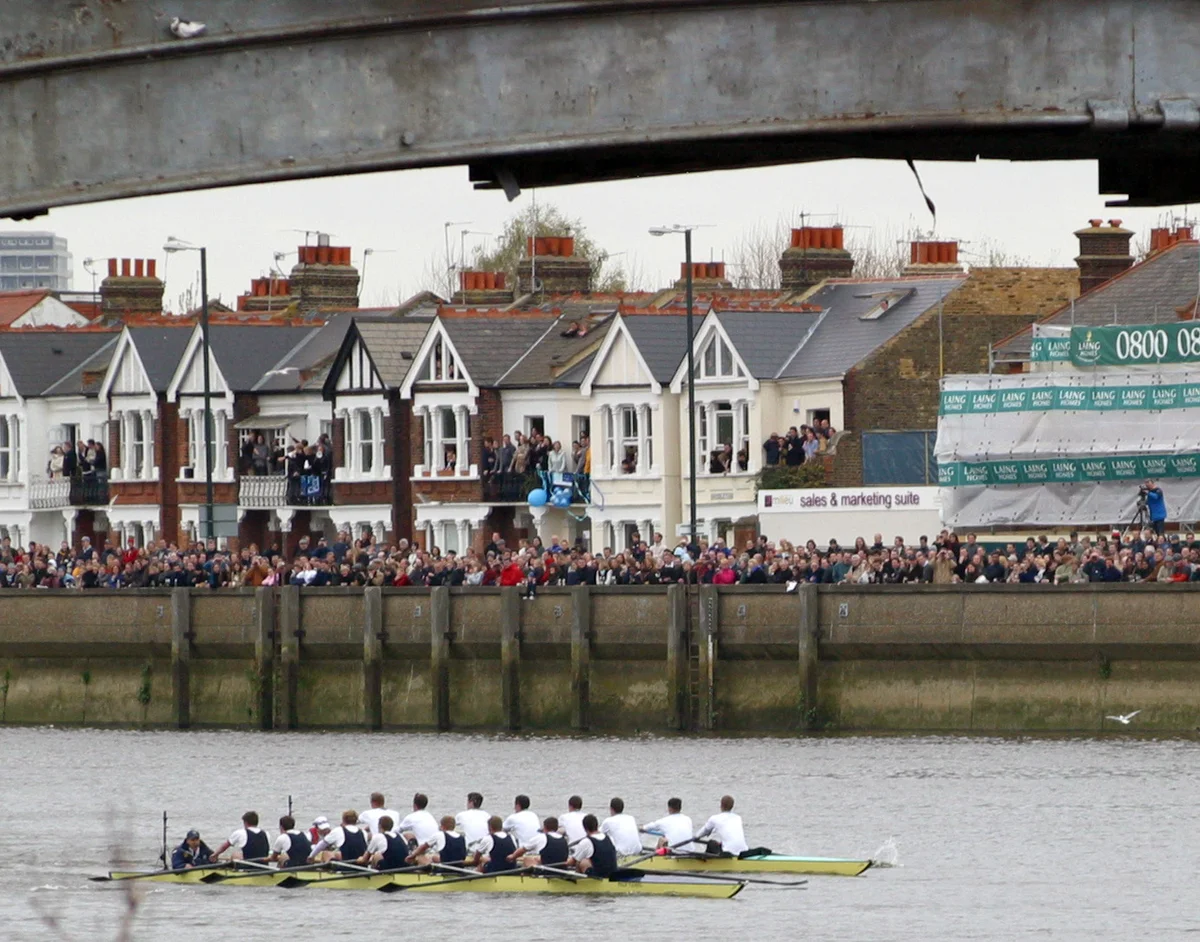
The Oxford and Cambridge Boat Race passes directly through Barnes every spring, and the stretch of river around Barnes Bridge has become the most dramatic section of the course. With two hundred thousand or more spectators lining the banks, the race is one of Britain’s oldest and best-known sporting events – and Barnes is at the centre of it.
The Championship Course
The first Boat Race was rowed at Henley-on-Thames in 1829. In 1845 the race moved to the Thames Championship Course, running from Putney Bridge to Mortlake Church tower – a distance of four miles and 374 yards (6.8 km). This course has been used for every men’s race since, except in 1846, 1856, and 1863 (when the direction was reversed) and 2021 (when the race was held at Ely due to COVID-19 and the closure of Hammersmith Bridge).
Barnes Bridge
By the time the crews reach Barnes Bridge, there are typically about three minutes of racing left. The river sweeps sharply around a bend towards the finish at Mortlake, and the crew on the inside gains a significant tactical advantage. A long-standing rule of thumb holds that “whichever crew is ahead at Barnes Bridge will go on to win the race” – though Cambridge disproved this in 1886 by coming from behind to win by two-thirds of a length.
In the twenty-first century, Barnes Bridge has been closed to pedestrians during the race on public safety grounds due to the density of the crowd.
Watching from Barnes
The Terrace is one of the prime spectator locations. The Georgian houses with their riverside balconies provide elevated views, and good-natured crowds line the pavement, especially opposite the riverside pubs. A familiar tradition sees spectators rush inside after the boats pass to watch the Mortlake finish on television.
The principal pubs for watching include:
- The White Hart – three verandas and rows of balconies; hosts a Boat Race Gala Lunch with first-floor views, barbecues, outdoor bars, and live music
- The Bull’s Head – situated near the finish line; hosts Boat Race parties with Sunday roasts, live jazz, and activities for children
Notable Races
The Dead Heat (1877)
On 24 March 1877 both crews finished in 24 minutes 8 seconds. Judge John Phelps (“Honest John”) called a dead heat – the only one in the race’s history. The controversy led to the introduction of finishing posts and the appointment of former Blues as umpires.
Both Boats in Trouble (1912)
On 30 March 1912, in atrocious weather, Cambridge sank off Harrods Furniture Depository and Oxford also shipped water. The umpire declared “No Race,” and it was re-rowed the following Monday, when Oxford won by six lengths.
The Closest Finish (2003)
On 6 April 2003 Oxford held a three-quarter-length lead at Barnes Bridge. In a ferocious sprint finish, Cambridge closed the gap, but Oxford held on to win by just one foot (30 cm) – the smallest margin in the race’s history. Steve Redgrave called it “the greatest we will see in our lifetimes.”
Women’s Boat Race
The women’s race was first held in 1927. From 2015 it has been rowed on the same Championship Course as the men’s race, on the same day. In 2025 the women’s race achieved a peak television audience of 2.18 million – the most-watched female sporting event in the United Kingdom at the time of its broadcast.
Community Impact
On race day, roads around Barnes close from the morning until late afternoon. Barnes Bridge shuts to pedestrians around 10:00. Local pubs, restaurants, and shops prepare for a major influx of visitors. The race reinforces Barnes’s identity as a riverside community and draws international attention to the neighbourhood.
Image sources
- boat-race.webp — Boat Race at Barnes Bridge, 2003. Author: Pointillist. Public domain. Source
Sources
- The Championship Course – The Boat Race (official website)
- The Boat Race – Wikipedia
- Spectator Information – The Boat Race
- Barnes Bridge in Life, Sport and Art – Hear The Boat Sing